Setup
A nightstand that works at three in the morning
Most bedside problems are layout problems. Four cables, a lamp switch you cannot find, and a display that is either invisible or blinding. This is how we would lay the surface out, and which of our five lines answers which complaint.
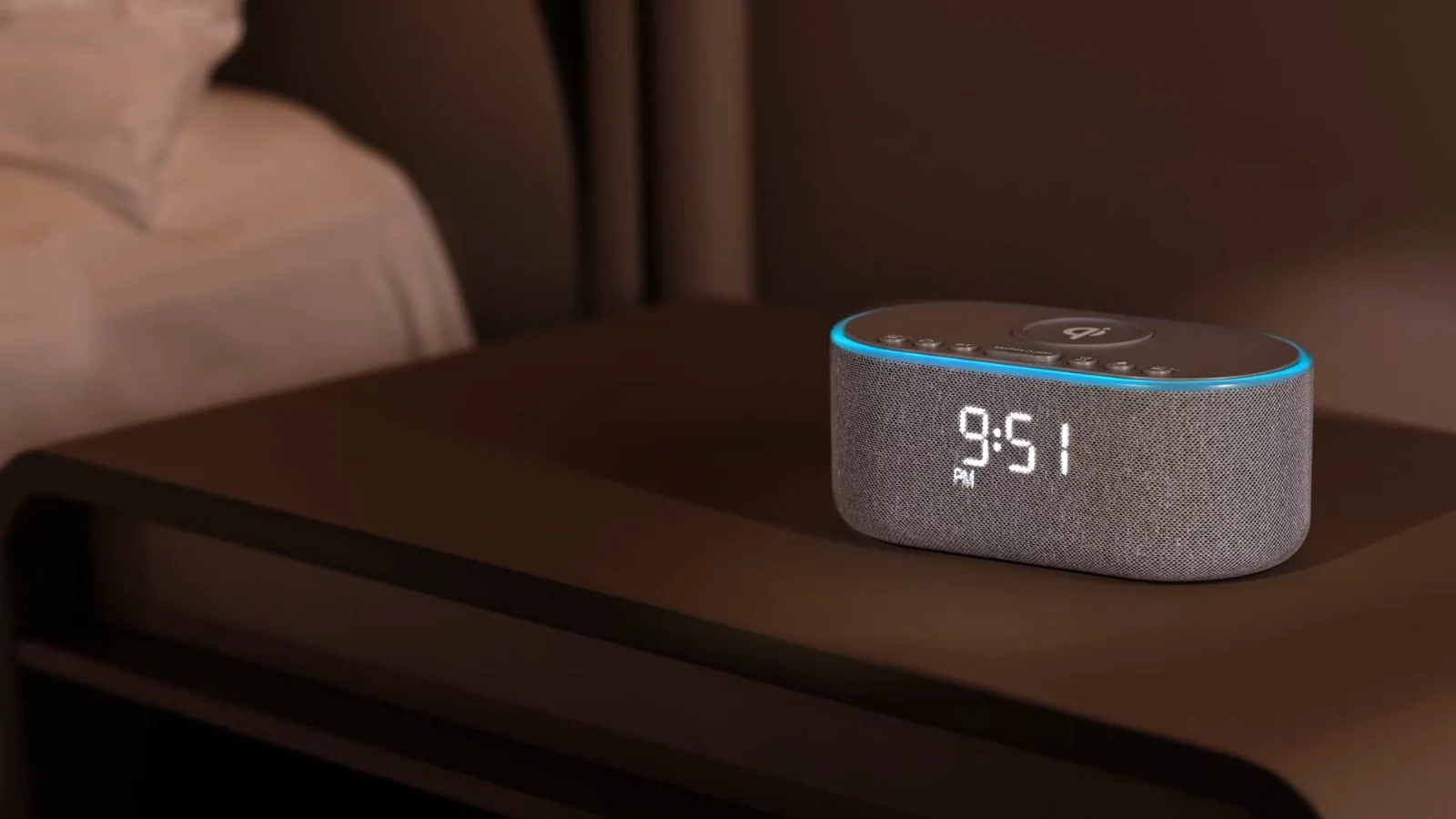
Not medical advice. This is a guide to arranging a piece of furniture, not health advice. If sleep is a persistent problem rather than an inconvenience, a clinician is the right person to talk to and a better nightstand is not.
Every complaint we get about a bedside clock is really a complaint about a surface. The clock is too bright, or the button is on the wrong side, or there is nowhere to put the phone, or the cable is not long enough to reach the socket behind the bed. These are furniture problems wearing an electronics costume.
So this is a guide to the surface. What goes on it, in what order, and which of the five things we make solves which specific irritation.
Start by counting the cables
Go and look at your nightstand. Count the mains plugs. The common answer is three: a lamp, a phone charger and a clock, and often a fourth for a speaker or a sound machine. Every one of those is a cable running down the back of a piece of furniture, and collectively they are the reason the surface is a mess and the reason nothing on it can be moved.
The single highest-value change available to most people is going from three plugs to two, or from two to one. That is the entire design brief behind our charging clock radio and our sound machine clock: they are not four features bolted together for a specification sheet, they are four cables removed from behind a bed.
The display problem
Two complaints, opposite in direction, from the same room.
The first: the clock is so bright that it lights the ceiling. This is the more common one, and it is the reason a lot of perfectly good clocks end up face down or in a drawer. The public sleep guidance is not ambiguous about the principle here: keep the bedroom dark, with a dim night light if one is genuinely needed, and keep bright artificial light out of the hour before sleep.
The second: the clock has a dimmer, but its lowest setting is still too bright. This one is more interesting, because it means the manufacturer thought about the problem and did not finish the job.
Our own answer changed over time, and one of the reviews we print on the front page is what changed it. An owner of the big-digit line told us the jump between the two lowest of its five brightness steps was bigger than it should be, and that at the lowest step the display was still not dark enough for them. That is a fair criticism of a stepped dimmer, and it is why every line we have designed since uses a continuous dial that runs all the way to a display which is genuinely off rather than merely faint.
Which to choose
If you want the time visible all night at a low glow, a stepped dimmer is fine and the big-digit line is the one with the largest numerals. If your ideal is a room with no light in it at all until you deliberately look, you want the dial, and that means the dual-alarm line, the charging clock radio or the sound machine clock.
Digit size and digit colour
Size is easy to reason about and almost never specified honestly. The dual-alarm line runs 1.6-inch numerals on a 4.9-inch display, which most people read comfortably at two to three metres. The big-digit line runs two inches, which holds up at three to four metres and, more to the point, holds up without correction for people who cannot focus at arm’s length the moment they wake up.
Colour is more personal and worth a paragraph because so few people think about it before buying.
| Colour | On which lines | What it is like in a dark room |
|---|---|---|
| Red | Big-digit, dual-alarm | Warmest and least intrusive. The traditional choice, and still the one most people ask for by name. |
| Green | Big-digit | Similar to red for intrusiveness, slightly higher apparent contrast. |
| White | Big-digit, dual-alarm, charging radio, sound machine | Highest contrast, easiest at distance, brightest at any given step. Use the dimmer. |
| Blue | Big-digit, dual-alarm, charging radio | Cool and clean. Divides opinion more than any other colour we offer. |
| Pink | Big-digit | The gentlest reading we make. Usually bought for a child’s room. |
| RGB or colour-changing | Dual-alarm | Pick per room, or per person. Useful when two people disagree. |
The shell colour and the digit colour are separate decisions. The shell is a daytime choice; the digits are a night-time one.
Reach: what your hand must find
At the moment an alarm fires you are not a competent operator of small electronics. You have one arm out from under a duvet, your eyes are half open and your fine motor control is worse than it will be at any other point in the day. Anything that requires locating a small button by feel will be solved by hitting the whole device.
Three things follow from that, and they are the three we design to.
- A large snooze surface. Not a button, a bar, wide enough to be hit with a palm rather than a fingertip.
- Alarm off switches on the front face rather than underneath or behind. On the dual-alarm line there are two of them, one per alarm, both reachable.
- Every setting control on the front too. This is why the big-digit line has its whole row of buttons on the face rather than on the top, where every other clock puts them.
The corollary is that the clock has to be within reach in the first place. A clock across the room is a genuine strategy for people who turn alarms off in their sleep, but it is a strategy that trades one problem for another, and it needs a second person in the house who does not mind.
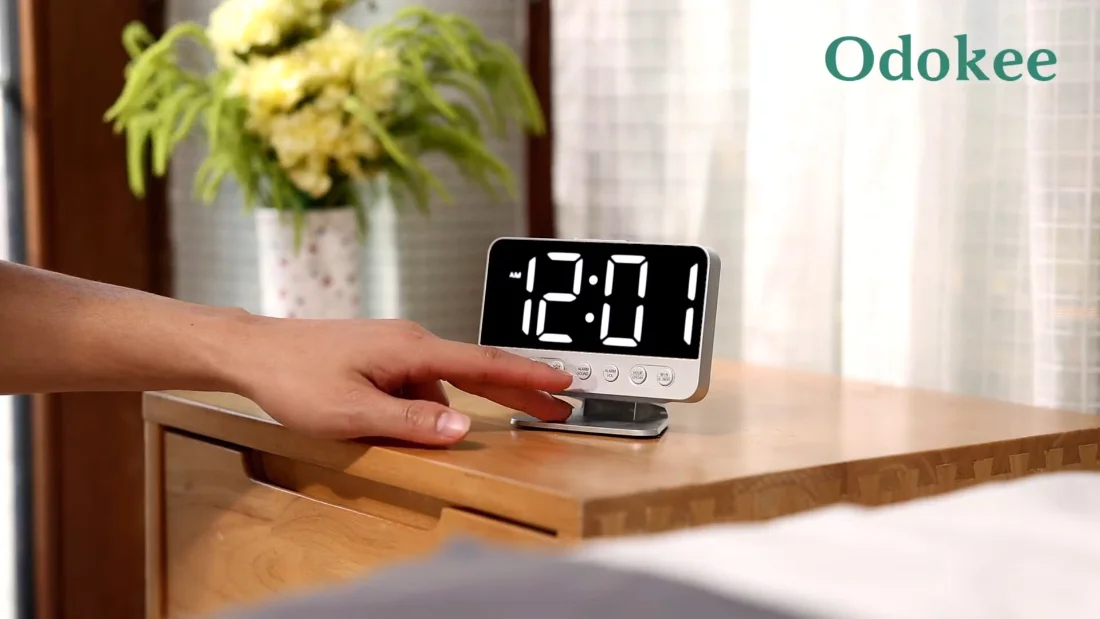
The alarm itself
Four things matter and only one of them is loudness.
The ramp
Every alarm we build starts below the level you set and climbs to it. An alarm that arrives at full volume in its first second is not a louder alarm, it is a worse one: it wakes you the same amount and it costs you the next twenty minutes of mood. The ramp is the single most underrated setting in this category.
The range
Ours run from about 30 to about 110 decibels. The bottom of that range is for people who wake at anything and want the smallest possible nudge. The top exists for people who genuinely sleep through everything, and it is worth being clear about what it means: national hearing-health guidance puts sirens at 110 to 129 dBA and notes that long or repeated exposure at or above 85 dBA can cause hearing loss. A few seconds once a day is a different exposure from a shift on a factory floor, but the maximum setting is not somewhere to leave a clock that sits a foot from your ear.
Two alarms, two patterns
Two people in one bed almost never get up at the same time, and the same person rarely gets up at the same time on a Saturday. The dual-alarm line carries two entirely separate alarms, each with its own time, its own tone and its own pattern: every day, weekdays only, or weekends only. It is the least glamorous thing on this list and the one that stops the most arguments.
The sound itself
Five tones on the dual-alarm and big-digit lines, seven on the sunrise light, eight on the sound machine. Birds, beep, soft music, a buzzer, a siren, and so on. One owner in our reviews notes that the sunrise light’s alarm options lean heavily towards bird sounds, and they have a point. If a particular tone matters to you, Bluetooth on the two larger machines will play whatever you like instead.
Charging, and what 10W actually means
The pads on the charging clock radio and the sound machine clock are Qi certified. That certification is administered by the Wireless Power Consortium through independent test laboratories, only products that pass may carry the logo, and there is a public database in which any specific model can be looked up. What it certifies is safety and interoperability: that the pad behaves correctly with any Qi phone.
It does not certify speed, and we would rather say so than let the badge imply it. Baseline Qi is 5W, the extended profile reaches 15W, and our pads are rated at 10W. That is quicker than a basic pad and slower than a good cable. One of the reviews on our front page says exactly this, from an owner who bought the clock specifically to keep a phone off a cable in a bed and found the charge slower than expected. They are right, and it is the correct trade only if the phone is going to sit there all night anyway.
The USB port on the back of every line is the other half of the answer. It runs at the same time as the pad, and it is where the second device goes: earbuds, a watch, a partner’s phone.
The power cut question
Every clock we make has a backup compartment, and none of them ships with cells in it. This trips people up, so it is worth stating plainly what backup does and does not mean.
With batteries fitted, a power cut does not reset the clock and does not stop the alarm from firing. The display stays dark throughout, deliberately: lighting a seven-segment display from AAA cells would flatten them in a few hours, and the point of the backup is to survive an outage of unknown length. Without batteries, the clock resets and a morning alarm does not happen.
Two AAA cells on the big-digit line, three on the dual-alarm. Fit them the day the clock arrives and forget about them, which is the whole idea.
Twice a year, everything moves
The seasonal clock change is a small annual tax on any sleep schedule. The American Academy of Sleep Medicine argued in a 2024 position statement that it should end in favour of permanent standard time, on the grounds that standard time aligns best with human circadian biology. Until something changes, the practical question is whether your clock moves itself.
The sound machine line does, automatically. The others do not, and moving them takes a few seconds. It is the one morning in the year when having every button on the front face is unambiguously the right design.
Which line for which complaint
| The complaint | The line | Why |
|---|---|---|
| I cannot read my clock without glasses | Big-digit, U2 | Two-inch numerals, five brightness steps, controls on the front face. |
| My clock lights up the whole room | Dual-alarm, UE218 | A continuous dial that runs the display to nothing at all. |
| Waking up is violent | Sunrise light, H03 | Light starts up to an hour early and climbs; sound is optional or off entirely. |
| My nightstand has four cables on it | Charging clock radio, UE268 | Clock, Qi pad, USB, FM radio and speaker in one plug. |
| The room is too quiet, or too noisy | Sound machine, UE268S | Twenty one sounds through a 10W stereo driver, plus the charging pad. |
| My clock works but the cord died | Spares | The exact replacement adapter, not a universal one. |
Prices run from $14.99 for the dual-alarm line to $59.99 for the sunrise light. Every line has a page of its own with all its colours on it.
A worked layout, left to right
For a right-handed sleeper on the right-hand side of a bed, with a nightstand about eighteen inches deep. Mirror it if you sleep on the other side.
- Far corner, back: the clock or sound machine, pushed away from the pillow side. Six extra inches of distance takes the edge off both the light and the sound.
- Front edge, nearest hand: nothing at all. This is the space you will need for a glass of water, a book, or whatever you are holding when you get into bed. Leaving it empty is a decision, not an accident.
- Middle: the charging pad, if it is a separate object rather than the lid of the clock. If it is the lid of the clock, you have already saved this space.
- Behind, out of sight: one plug. Everything on the surface should trace back to a single cable, which means a single thing to unplug when the furniture moves.
- Nothing on the surface that lights up on its own. Router indicators, charger LEDs and standby lights are all small violations of a dark room, and a strip of electrical tape is a legitimate design tool.
The five lines we build all sit together on the front page of Odokee clocks, arranged by the hour of the night each one is for, and each has a page with every colour on it. If you are choosing between the sunrise light and something simpler, the guide to how light wakes people is the one to read next.
The lamp question
A bedside lamp and a bedside clock are usually bought separately and almost never considered together, which is a mistake because they compete for the same job and the same space.
The job is this: at some point in the night you will need enough light to find a glass, a book or a door, and you will need it without waking anybody or resetting your own eyes. A ceiling light is useless for that. A bright bedside lamp is nearly as bad. What works is a small, warm, low source that comes on at a level you chose in advance.
Four of our five lines have that built in and most people never switch it on. The big-digit line carries an eight-colour glow along its base, dimmable, with an off position. The charging clock radio has eight night-light colours with their own brightness control. The sunrise light has twelve plus a sunset fade. In each case the point is not decoration: it is that a device already plugged in at the right place can replace a lamp you would otherwise have to buy, plug in and reach for.
If the room genuinely needs a reading lamp as well, put it on the far side of the clock rather than between the clock and the bed. Its switch is the thing you will be reaching for in daylight; the clock is the thing you will be reaching for in the dark.
Two people, one surface
Most bedside advice quietly assumes one occupant. Beds usually have two, with different wake times, different tolerances for light and frequently different opinions about the colour of a display.
The cheapest solution is also the best one: a clock each. Two of the dual-alarm line is under forty dollars, and it gives each person their own brightness setting, their own alarm and their own digit colour without any negotiation. It is the arrangement we would choose ourselves, and it is not the one people expect a manufacturer to recommend when a single clock with two alarms exists.
If it has to be one machine, the two-alarm arrangement is what the dual-alarm line is for: separate times, separate tones, separate weekday patterns, both switches on the front. The cost is that both people hear both alarms, which is fine when the two times are ten minutes apart and much less fine when they are ninety.
The third option only exists because of the sunrise light: one person on light with no sound at all, the other on a conventional alarm an hour later. The room lifts a little at the earlier time and nobody is jolted. It is the only one of the three that a bedside clock alone cannot deliver.
What we would put on a surface with one plug
To close with something concrete, here is the shortest list that covers every function a nightstand actually needs, in each of the three price brackets we sell into.
| Budget | What goes on it | What it covers | What it does not |
|---|---|---|---|
| Under $20 | One dual-alarm clock | Time, two alarms, a dimmer to black, a USB port for the phone | Audio of any kind, wireless charging, a night light |
| Around $45 | One charging clock radio | All of the above plus a Qi pad, FM radio, a 10W speaker and eight night-light colours | A sleep sound library, a sunrise |
| Around $55 | One sound machine clock, or one sunrise light | Sleep sounds and a timer, plus either wireless charging or a sunrise and a night light | Both of those at once. There is no single machine that does everything. |
A fourth arrangement is worth mentioning: a sunrise light on one side and a dual-alarm clock on the other, which is under eighty dollars and covers more ground than any single device we make.
Questions we get asked
How many things should be on a nightstand?
Fewer than are on yours. The practical target is one plug: a single device that is the clock, the light, the charger and whatever audio you need, plus a lamp if the room has no other light. Everything past that is a cable you will knock off in the dark.
Wireless pad or cable?
Pad, if the phone is going to lie there for eight hours anyway. Cable, if you need it full before you leave. A 10W Qi pad is not fast and we are not going to pretend otherwise.
Which digit colour is easiest at night?
Red and green sit lowest on a dark-adapted eye; white gives the highest contrast and is easiest to read at distance; blue is in between and is the one people either love or cannot stand. If you check the time often, go red or green. If you struggle to read it at all, go white and use the dimmer.
What happens in a power cut?
With batteries in the backup compartment, the clock keeps time and the alarm still fires. The display deliberately stays dark, because lighting it would flatten the cells in hours. Without batteries, the clock resets and the alarm does not fire.
Do I need a clock at all if I have a phone?
You need something that shows the time without also showing you a notification. Whether that is a clock, a watch on the table or a phone in aeroplane mode face down is up to you. We build clocks because the phone version rarely survives contact with a bad night.
 Prices come from our last update.