Sound
White, pink, brown: what a sound machine is actually doing
Twenty one sounds is a menu, not a feature list. Here is what the noise colours really are, which of them suits which problem, why the speaker matters more than the count, and the volume advice we would rather you heard from us than from a footnote.
Not medical advice. Sound machines are consumer audio products. They are not treatments for insomnia, tinnitus or any other condition, and nothing below is medical advice. The volume guidance here is drawn from published public-health material and is worth following whatever brand of machine is in the room.
A sound machine is doing one job, and it is not the job most product pages describe. It is not making the room peaceful. It is making the room uniform.
What wakes people at night is almost never a constant noise. It is a change: a car door, a floorboard, a partner turning over, a fridge compressor starting. Sleep is remarkably tolerant of steady sound and remarkably intolerant of a step in it. A masking sound works by raising the floor, so the step from silence to car door is smaller and stops being an event.
Everything else about these machines follows from that. The sounds are chosen to be steady. The speaker is sized so that steadiness is convincing. The timer exists because the floor you need at eleven at night is not the floor you need at four in the morning.
The noise colours, without the mysticism
The colour names are borrowed from light and describe how energy is distributed across the frequency range. That is the whole story. There is nothing spiritual about brown noise.
White
Equal energy at every frequency. Because human hearing is far more sensitive in the upper middle range, white noise sounds bright and hissy, closer to an untuned radio than to anything in nature. It masks well and a lot of people find it fatiguing.
Pink
Energy falling as frequency rises, which makes it sound balanced rather than bright. Pink is close to a lot of natural sound: steady rain, wind through trees, a distant river. It is the safest default if you do not want to think about it.
Brown
Falling faster still, so the low end dominates. Brown noise sounds like a waterfall heard through a wall, or like the inside of an aircraft. It masks low-frequency intrusion better than anything else on the list. Try it first against traffic, bass from a neighbour, or snoring.
Blue
The opposite of pink: energy rising with frequency. It is bright, thin, and rarely anyone’s favourite for sleep. It is on the list because a small number of people find it works for them and because it costs nothing to include.
The full menu, grouped
| Group | How many | What is in it | The problem it suits |
|---|---|---|---|
| Noise colours | 5 | White, pink, brown and two others | Steady masking. Brown for low-frequency intrusion, pink for general use. |
| Fans | 4 | Four different fan recordings at different speeds | A room that is too quiet, or anyone who grew up sleeping next to one. |
| Outdoors | 6 | Rain, thunderstorm, brook, wind, waves, birds | Rooms where a plain hiss feels clinical. Rain is the most requested sound we carry. |
| Lullabies | 2 | Two melodic loops | Children, mostly. |
| Body sounds | 2 | Heartbeat and a shushing loop | Infants, and adults who find rhythm easier than texture. |
| Calm | 2 | Yoga and meditation beds | Winding down before sleep rather than during it. |
The sunrise light carries a longer list of twenty five, weighted more towards the outdoor recordings and less towards the body sounds.
Why a small speaker cannot do rain
This is the part of a sound machine that a specification sheet hides. Rain is mostly low and mid-frequency energy with a fine high-frequency texture on top. A small driver reproduces the texture and loses the body, and what comes out is a hiss. Your ear identifies it as a speaker within about a minute, and identifying the source is exactly the failure mode you were trying to avoid.
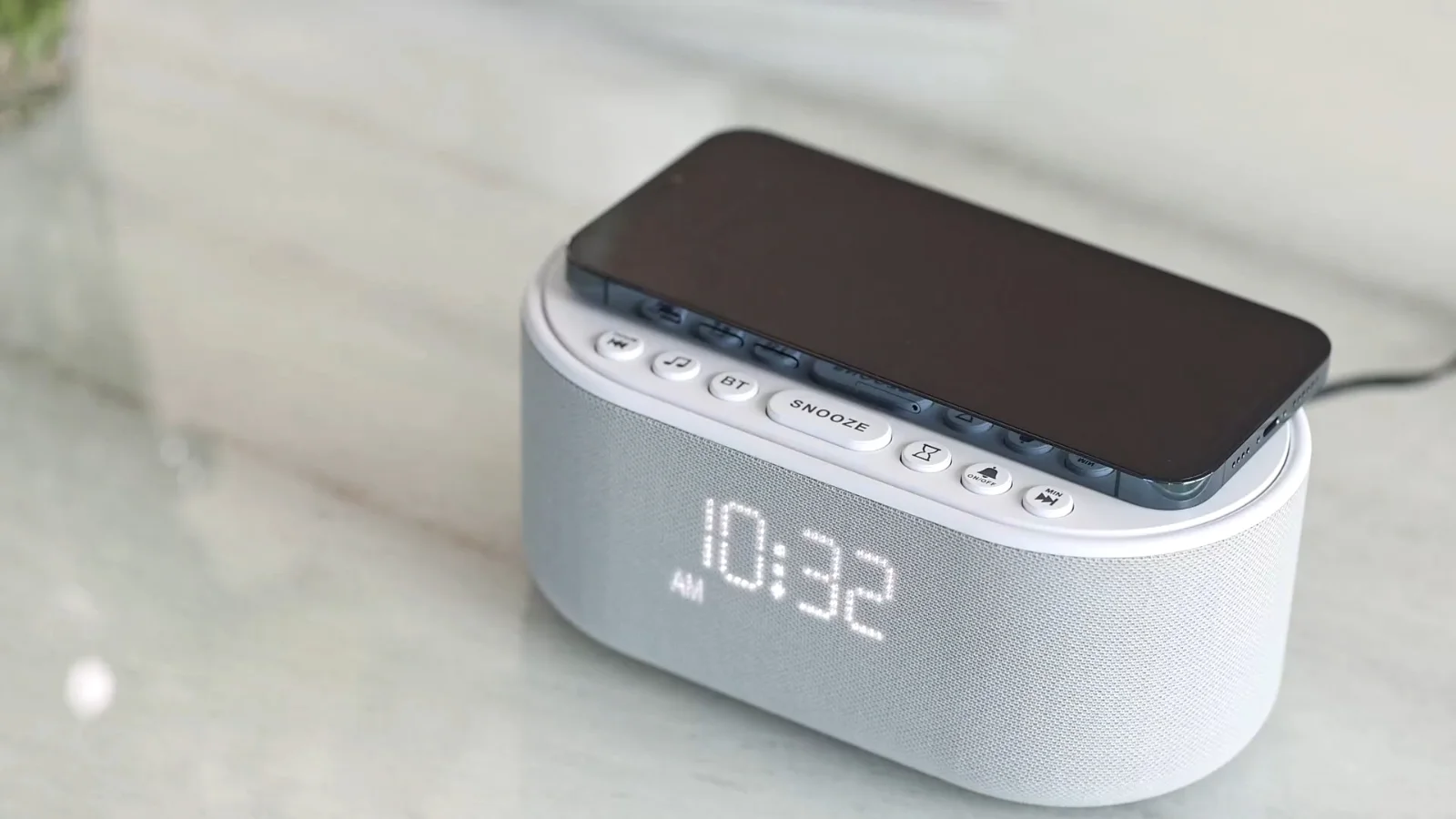
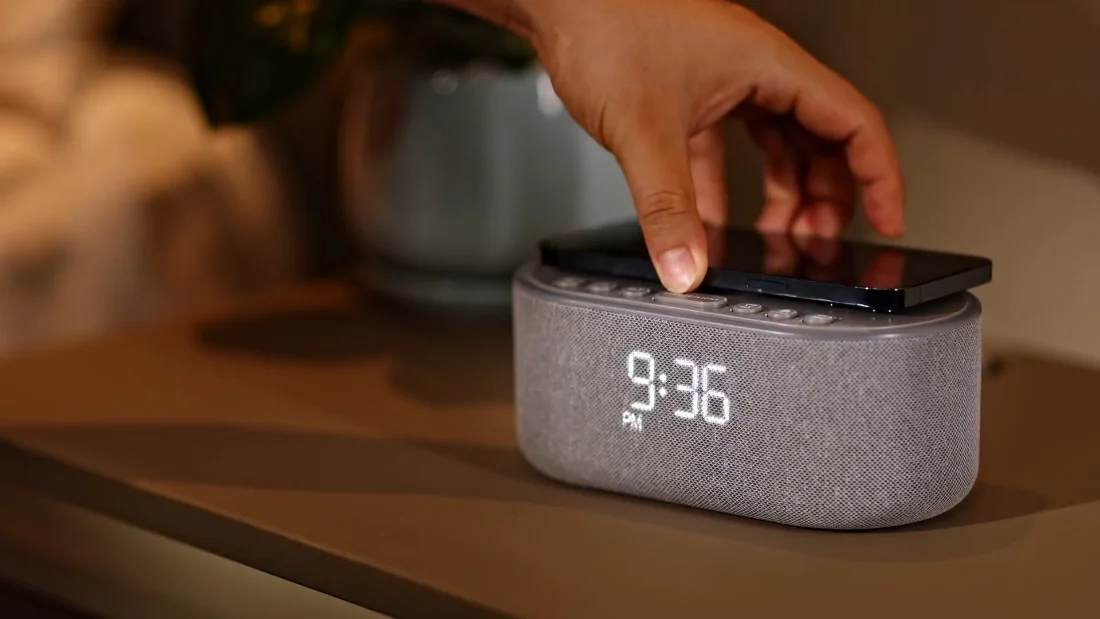
The sound machine line runs a 10W stereo driver in a fabric-wrapped enclosure, which is enough to give brown noise and rain the low end they need. The fabric is not styling: a knit surface absorbs a little of the room instead of ringing, and it keeps heat off a phone sitting on the charging pad above.
The same driver is what makes the machine useful for anything else. If it can carry rain convincingly, it can carry a podcast or an album, and the Bluetooth connection is there so the built-in list is not a limit.
How loud, and for how long
Here is the part we would rather over-explain than under-explain, because it is the only genuine safety question a sound machine raises.
The National Institute on Deafness and Other Communication Disorders states the threshold plainly: sound at or below 70 A-weighted decibels is unlikely to cause hearing loss however long it goes on, while long or repeated exposure at or above 85 dBA can. For scale, the same page puts normal conversation at 60 to 70 dBA and sirens at 110 to 129.
A sound machine at a sensible bedside level sits well under that lower threshold. The reason to think about it at all is that these machines can go louder than they need to, they run for hours, and they run close to a head.
| Sound | Roughly | What it means for a machine running all night |
|---|---|---|
| A quiet bedroom | 25 to 30 dBA | The floor you are raising. |
| A sound machine set sensibly | 45 to 55 dBA | Comfortably below the 70 dBA line. This is where ours should live. |
| Normal conversation | 60 to 70 dBA | Louder than a sound machine needs to be. |
| The threshold of concern for long exposure | 85 dBA | Long or repeated exposure at or above this can damage hearing. |
| Our alarm at maximum | up to 110 dBA | A few seconds once a day for the deepest sleepers, not a setting to leave running. |
Figures for everyday sounds are from the national hearing-health guidance linked below. The alarm figure is our own specification.
The practical rule we use: set the level in the evening with the room as it will be, then turn it down one step. A sound set against evening traffic is set too high for four in the morning, when the road is empty and the machine is the loudest thing in the room.
Children, and the sentence we will not bury
A lot of these machines are bought for a child’s room, so this belongs in the body of the page and not in a footnote.
Paediatric guidance is direct about it: some infant sleep machines can produce hazardous noise levels, and if one is used it should be placed as far from the baby’s head as possible and run for a short time only. That advice applies to ours exactly as much as to anyone else’s. Across the room, at a low setting, on the sleep timer.
What we would do in a nursery
Put the machine on a chest of drawers on the far wall rather than on the cot, choose a fan loop or pink noise rather than something with peaks in it, set the volume where you can still hold a normal conversation over it, and use the timer rather than leaving it running until morning.
The timer is the feature nobody reads about
Every sound machine we make has one, and it is the setting we would change first on a machine somebody was unhappy with. Masking is most useful while you are falling asleep and during the first hour, when a small noise can still pull you back. By the middle of the night, most people are past the point where it earns its keep, and the machine has become a thing you are listening to for six hours for no reason.
There is a second argument for it that has nothing to do with ears. A machine that stops at 23:40 is a machine you will notice if it breaks. A machine that runs from dusk to dawn every night for two years becomes furniture, and nobody ever adjusts furniture.
Where to put it
Three rules, in order of how much difference they make.
- Not on the pillow side of the nightstand. Push it to the far edge. Six extra inches of distance is a meaningful reduction in level at your ear and costs nothing.
- Facing into the room rather than at the bed. You are trying to fill a space, not aim at a person. A machine pointed at a wall a metre away does this better than one pointed at your head.
- Away from anything that rattles. A fabric-wrapped speaker on a hollow bedside cabinet will find the resonance in that cabinet at three in the morning. A book or a felt pad under it solves the problem permanently.
The general sleep guidance asks for a bedroom that is quiet, cool and dark. A sound machine is not a contradiction of the quiet part: a steady low sound is much closer to quiet, in the sense your sleeping brain cares about, than an intermittently noisy room is.
What a sound machine will not do
It will not treat insomnia. It will not fix tinnitus, although some people find masking makes the evening easier and that is a conversation to have with an audiologist rather than with a product page. It will not compensate for a room that is genuinely too loud to sleep in, because masking has limits and a passing motorbike will exceed them at any setting you would be willing to sleep next to.
What it will do is take the edges off a room that is nearly quiet, and make the difference between a night with four small wakings and a night with one. That is a real thing worth fifty dollars, and it is what we build these for.
We make two machines that do this. Here is which one.
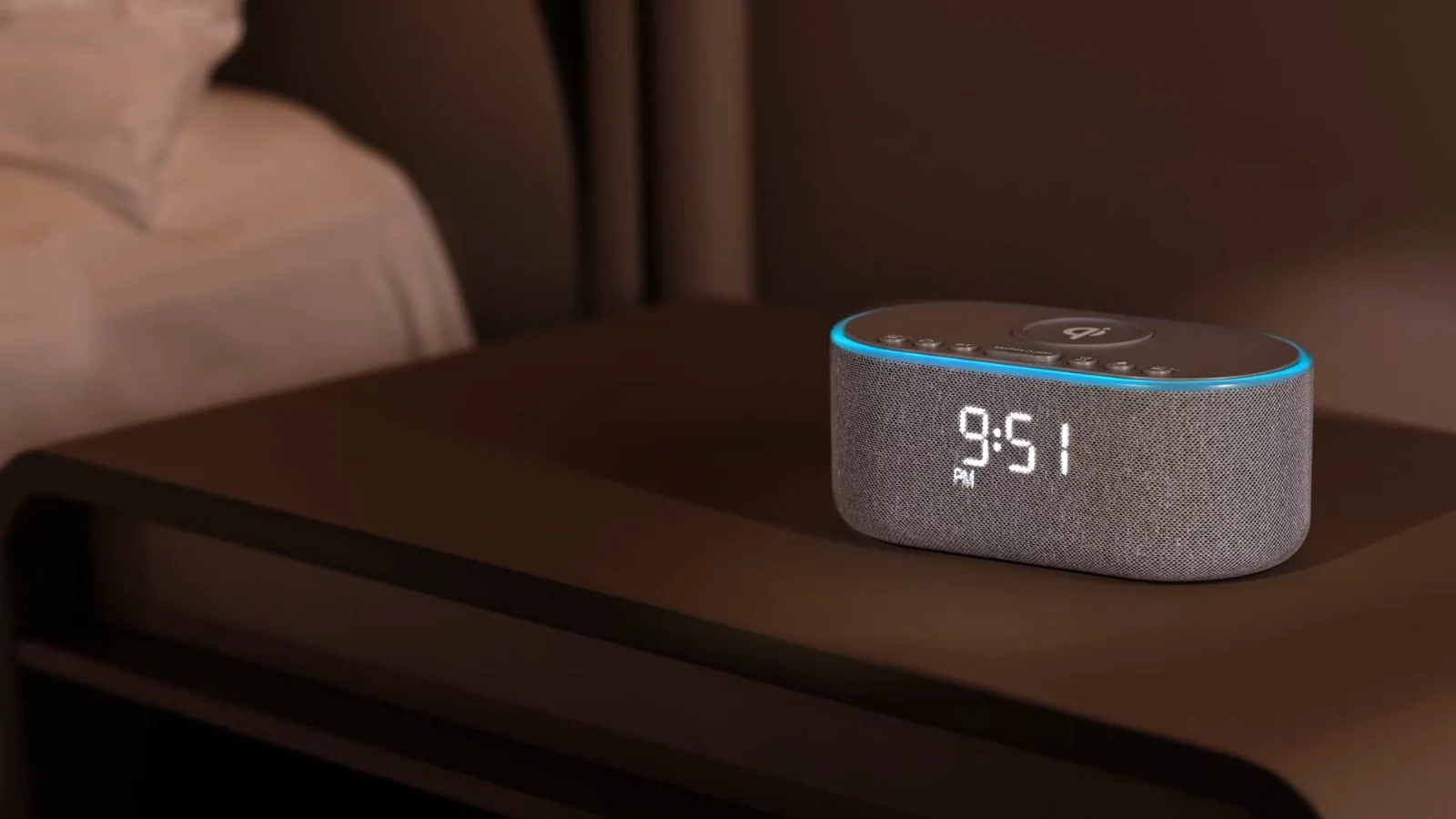
The sound machine clock and the sunrise light both carry a sound library, a sleep timer and Bluetooth, and people reasonably ask which of the two they should buy. The answer depends entirely on which end of the night is the problem.
| Sound machine, UE268S | Sunrise light, H03 | |
|---|---|---|
| Sounds | 21, weighted towards noise colours and fans | 25, weighted towards outdoor recordings |
| Speaker | 10W stereo | 5W |
| Charging | 10W Qi pad plus USB port | None |
| What it does in the morning | Alarm with eight tones | Light from up to an hour early, sound optional |
| Night light | Display dimmer only | Twelve colours plus a sunset fade |
| Price | $52.99 to $54.09 | $53.99 to $59.99 |
| Buy it if | The evening is the problem and the nightstand is crowded | The morning is the problem |
If both halves are the problem and you can only have one plug, the sunrise light covers more ground; if the sound quality is what you are buying, the larger speaker is on the sound machine.
The rest of the Odokee range is on the front page, arranged by the hour of the night each line is built for.
Bluetooth, and what to do when the list is not enough
Twenty one sounds sounds like a lot until you have lived with one machine for a year, at which point you have a favourite and the other twenty are decoration. Both our larger machines take a Bluetooth connection for exactly that reason, and the sleep timer works on whatever is playing through it.
This matters more than the count for two reasons. The first is that people who use sound to fall asleep frequently do not want noise at all: they want a specific podcast, a specific album, or a recording of rain they have been attached to for a decade. The second is that a built-in library ages. A Bluetooth connection does not.
The argument for having a built-in library at all is simpler: it means you do not need a phone in the bed. That is the entire reason we keep expanding the on-board list rather than treating the speaker as the whole answer. A machine that only works when a phone is paired to it has put the phone back on the nightstand, which is the thing half our customers were trying to get rid of.
Five mistakes we watch people make
- Setting the volume at eleven at night with the window open. The room is at its loudest then, and at four in the morning the machine will be the loudest thing in it. Set it, then take it down a step.
- Putting it between the pillow and the wall. That is the worst position available: closest to the ear, and reflecting off a hard surface straight back at it. The far corner of the surface is better in every way.
- Choosing white noise because it is the one whose name they know. White is the brightest and most fatiguing of the colours. Pink or brown is the better starting point for almost everybody.
- Leaving it on all night on the first night and concluding it does not work. Masking helps most while you fall asleep. Use the timer and judge it on how long it takes you to drop off, not on how the whole night went.
- Buying one for a nursery and putting it on the cot rail. Paediatric guidance is specific: as far from the head as possible, low, and for a short time.
None of those is exotic. All five come up in messages we get, and four of them are settings rather than purchases. We would rather write this than sell somebody a second machine.
Questions we get asked
Which sound should I start with?
Brown noise if the problem is traffic, voices or a snoring partner, because it has the most low-frequency energy and masks the widest range of intrusions. A fan loop if the problem is a room that is too quiet. Rain if neither of those describes it and you simply want the room to feel occupied.
Should it run all night or on a timer?
A timer, if you can. It is easier on your ears, it is easier on anybody else in the room, and most people are past the part of the night where masking helps within about forty minutes. If you wake often and the silence is what wakes you, all night is a reasonable choice at a low volume.
Is it safe for a baby’s room?
Paediatric guidance says some infant sleep machines can reach hazardous levels and advises placing the machine as far from the baby’s head as possible and running it only for a short time. That applies to ours too. Across the room, low, on the timer.
Why does the same sound seem louder some nights?
Because the room is quieter. A masking sound set against evening traffic is set too high for three in the morning. This is the single best argument for the sleep timer: the sound stops before the room gets quiet enough for it to become the loudest thing in it.
Can I play my own audio instead?
Yes. Both the sound machine and the sunrise light take Bluetooth, and the sleep timer works on whatever is playing. The built-in list exists so that falling asleep does not require a phone in the bed.
 Prices come from our last update.