Light
Why light wakes you better than sound does
A sunrise alarm is a lamp on a long timer. Here is what that lamp is doing to the clock inside your head, what it cannot do, and how to set one up so that it works on a Tuesday and not only in a photograph.
Not medical advice. Sunrise lights are lamps on timers. They are pleasant, and for a lot of people they make mornings easier, but they are consumer products rather than treatments, and nothing below is medical advice. Persistent trouble sleeping or waking is worth taking to a clinician.
Almost everyone who has ever hated their alarm hates the same thing about it: the discontinuity. One second there is nothing, the next there is a siren, and the gap between those two states is the whole unpleasantness. A sunrise light is an attempt to remove the gap by putting something in it.
That is a modest description of a product, and we prefer it to the grander one. What follows is what we actually know about why the approach works, what it is doing biologically, where the evidence stops and the marketing begins, and how to set one of these things up so that it earns its place on a nightstand.
The clock you cannot see
There is a physical clock in your head. It is a cluster of nerve cells in the hypothalamus called the suprachiasmatic nucleus, and its job is to keep every other rhythm in the body pointing the same way: temperature, hormone release, alertness, digestion, sleep. The National Institute of General Medical Sciences describes it as the master clock, and describes its main input in one sentence: it controls melatonin production according to how much light the eyes receive.
That last part is the whole reason a lamp can do anything. Light is not one input among many for this system. Of everything that shifts a circadian rhythm, light and dark have the largest effect by a wide margin. Evening light tells the clock to hold off on melatonin. Morning light tells it that the day has started.
The master clock controls production of the hormone melatonin based on the amount of light the eyes receive.
It is worth sitting with the implication of that for a moment, because it cuts both ways and most people only hear one half. The half everybody knows is that screens at midnight are a bad idea. The half that gets less attention is that a dark bedroom at seven in the morning is also information, and the information it delivers is that the night is not over.
This is why winter mornings are harder than summer ones in a way that has nothing to do with temperature, and it is why the same alarm at the same time feels different in December. Your clock is not reading the numbers on the display. It is reading the room.
What an alarm actually interrupts
Sleep is not a flat state that you are either in or out of. It cycles, roughly every ninety minutes, through lighter and deeper stages, and the depth of the stage you are in when something wakes you has a great deal to do with how the next hour feels. Being pulled out of the deepest part of a cycle produces the thick, stupid, resentful feeling that has a name in the literature and no good name in ordinary speech.
A conventional alarm has no idea where you are in that cycle. It fires at 06:30 whatever is happening. A sunrise light does not know either, but it does something more useful: it spends the last half hour before 06:30 making your sleep progressively lighter, so that whatever the alarm eventually interrupts is less deep than it would otherwise have been.
That is the honest mechanism. Not that the light finds a good moment, but that it makes more of the moments good.
What a sunrise light is, mechanically
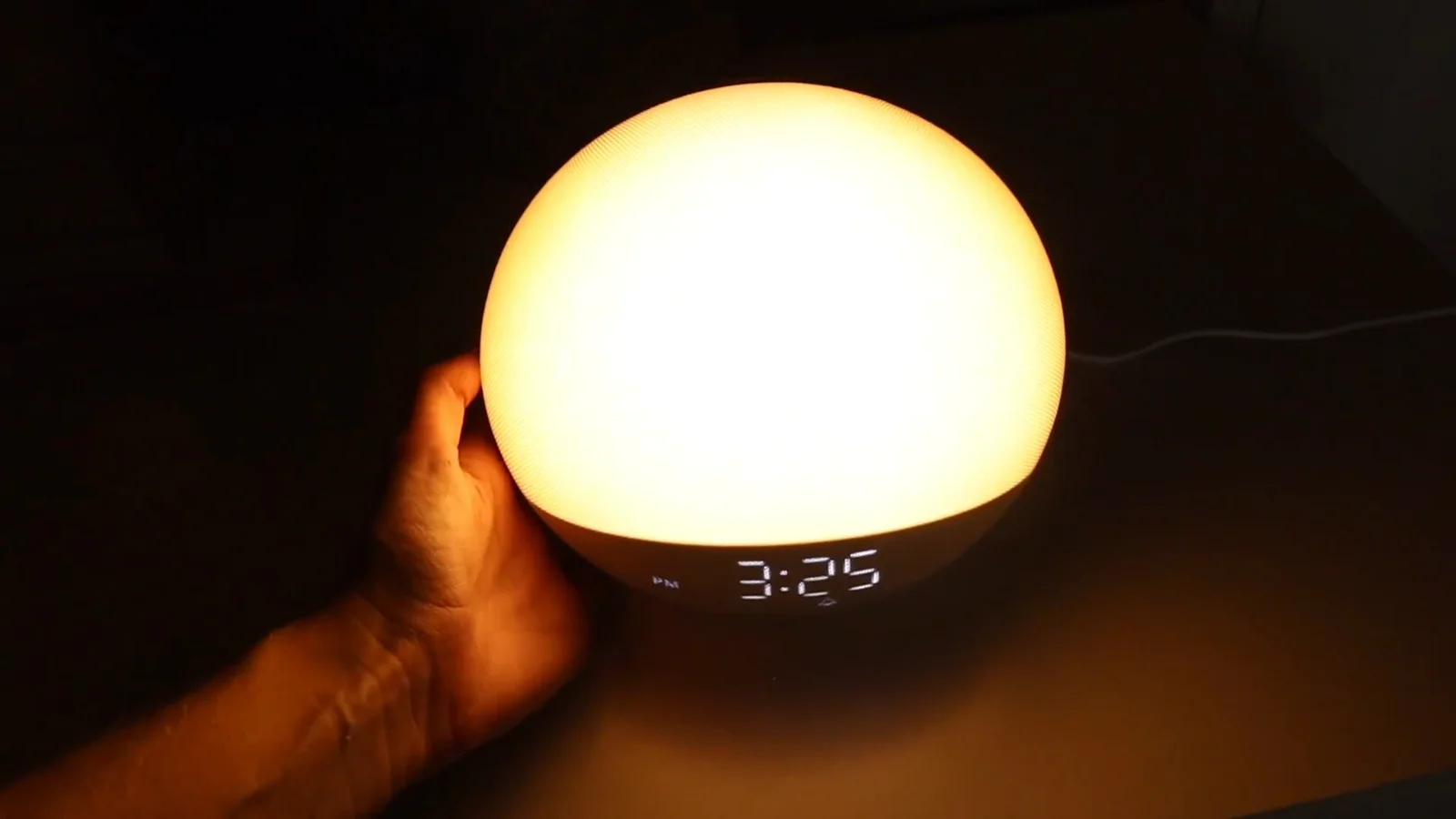
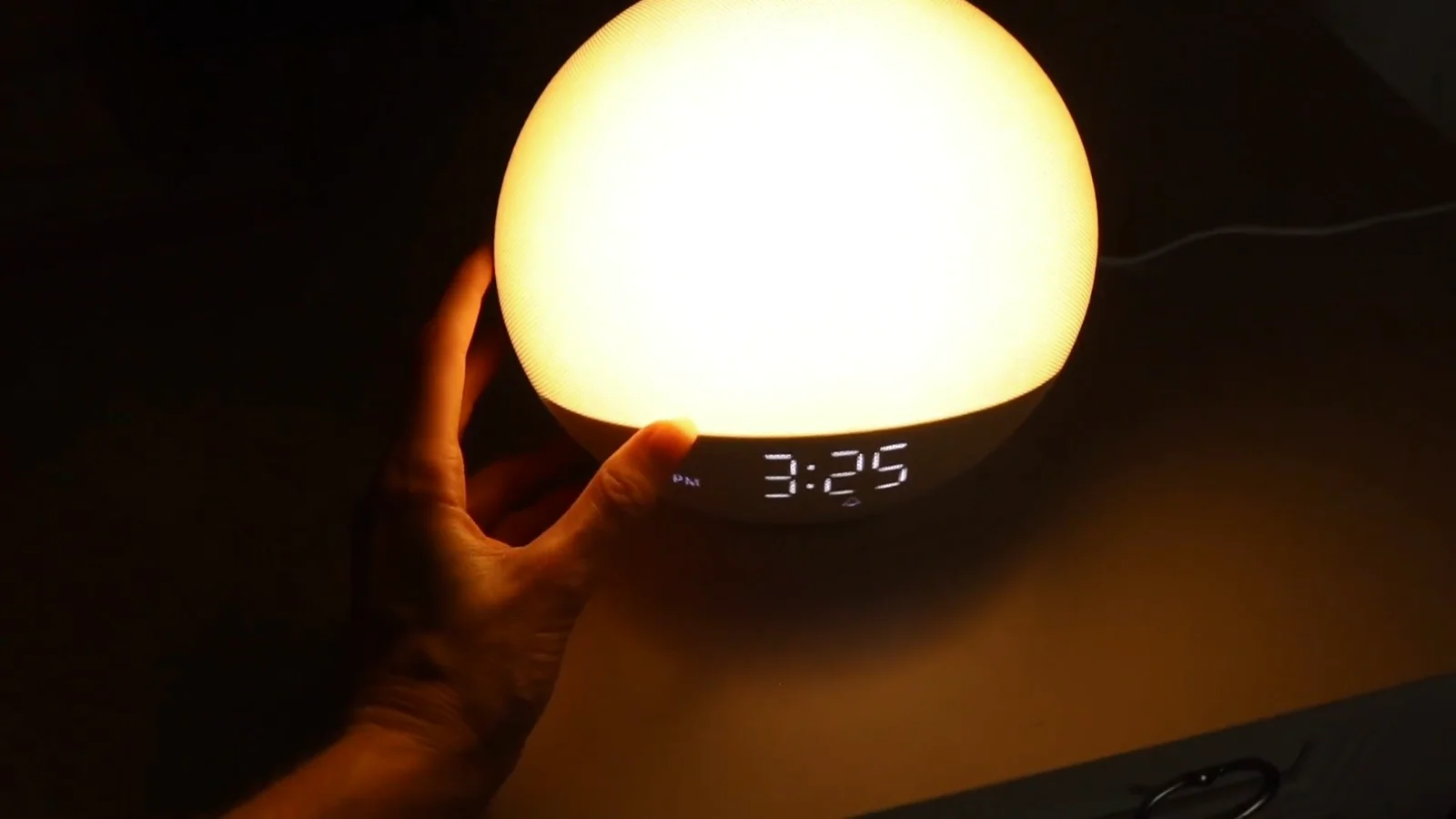
Strip the vocabulary away and the device is simple. A dome of diffusing plastic, an array of warm and cool LEDs behind it, a clock, and a controller that raises the output on a curve. Ours also has a speaker, a display and a night-light mode, but those are separate jobs sharing a body.
Three details matter more than the specification sheet suggests.
The curve, not the brightness
A light that jumps from off to half power at the fifteen minute mark is not a sunrise, it is a lamp with a timer, and your eyes will treat it as one. The value is in a smooth climb, so we let you choose the window rather than fixing it. Thirty minutes suits most people. Heavy sleepers do better at forty five or sixty. Anyone who wakes easily should go the other way, to fifteen or ten, or the light becomes an irritation rather than a signal.
Diffusion
The light has to arrive as a glow, not as a point. A bare LED at two feet from a face is a torch. The dome on the H03 is seven inches across for that reason: it spreads the same output over enough surface that the eye reads it as a lit room rather than as a lit object. It is also why a lux figure would tell you nothing here: a lux number without a distance and an angle is decoration, and with a diffuse source it is close to meaningless.
The option to have no sound at all
Three wake modes: light and sound together, sound alone, or light with nothing audible whatsoever. The third is the one people are usually surprised by, and it is the one that changes a household where two people get up ninety minutes apart. One person gets a sunrise. The other keeps sleeping.
Light against sound: an honest comparison
We make both kinds of clock, so we have no particular stake in the answer. Here is how the three approaches actually differ.
| Sound only | Light only | Light then sound | |
|---|---|---|---|
| Reliability on a workday | Highest. A loud enough alarm wakes almost anybody. | Variable. Depends on the sleeper and the season. | Highest, and gentler getting there. |
| How the first minute feels | Abrupt, especially from deep sleep. | Gradual. Often you are awake before you notice. | Gradual, with a backstop. |
| Effect on a partner | Wakes them too. | Lifts the room slightly. | Wakes them too, but later. |
| Works through an eye mask | Yes. | No. | Only the sound half. |
| Works in a fully blacked out room | Yes. | Yes, that is the point. | Yes. |
| If you oversleep, why | You turned it off in your sleep. | The window was too short, or your eyes were covered. | Rare. That is what the backstop is for. |
We would put anybody new to this on light plus sound for the first fortnight, then let them decide whether the sound is still doing anything.
Setting one up so it survives contact with a real week
Most sunrise lights that end up in a cupboard were set up once, at night, in a hurry, and never adjusted. Four decisions do almost all the work.
Where it sits
On the same side as your face, within about three feet, and not behind your head. A sunrise light on the far side of the room is a nightlight. It also should not be pointed at the wall: the dome is meant to be visible from the pillow.
How long the window is
Start at thirty minutes. Keep the sound on. After a week, notice whether you are awake before the sound arrives. If you always are, shorten the window or drop the sound. If you never are, lengthen it. This is a two week experiment, not a setting you get right on the first night.
What time the alarm is
The single most effective sleep advice in the public guidance is also the least popular: the same bedtime and the same wake time every day, weekends included, with about an hour of slack at most. The National Heart, Lung, and Blood Institute puts it first in its list of healthy sleep habits, ahead of everything about caffeine and screens. A sunrise light does not make an irregular schedule work. It makes a regular one pleasanter.
What the room does in the evening
The same guidance asks for a bedroom that is quiet, cool and dark, and for bright artificial light to be kept out of the hour before sleep, with a dim night light acceptable if one is needed. That is the other half of the job, and it is the half a sunrise light can help with too: the night-light mode exists so that the thing which lights the room at 23:00 is dim, warm and on a timer rather than the ceiling fixture.
A note on how much sleep
Adults are advised to get between seven and nine hours a night. If you are sleeping five and looking for an alarm that makes five feel like eight, no clock we or anybody else makes will do that. The lamp helps the transition. It does not add hours.
The evening half of the machine
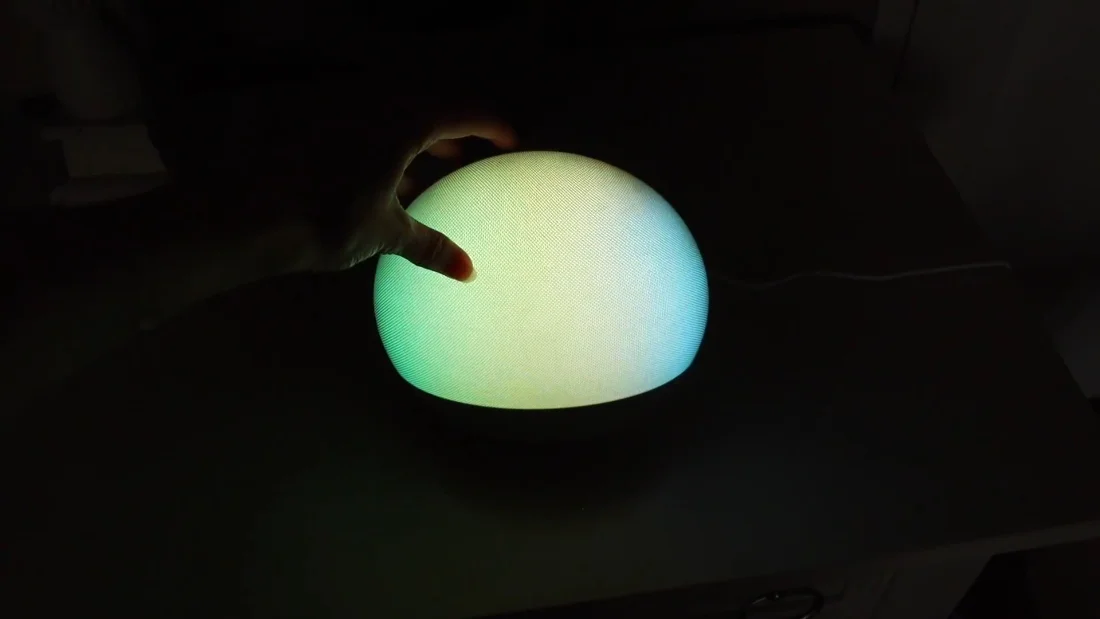
Half of what our sunrise light does happens twelve hours before the sunrise. Twelve night-light colours, each with its own brightness, plus a sunset setting that fades down rather than switching off. Twenty five sleep sounds and a sleep timer. A display dimmer that runs to zero, so the clock is not a light source when it is not being read.
The reason all of that lives in the same body is not feature-stuffing. It is that the surface next to a bed is small, and every device on it that has to be plugged in is another cable and another glowing indicator. One machine that handles the last hour and the first hour is genuinely better than two that each handle one.
If the evening half is the part you care about most, the sound machine line is built for exactly that job and is worth reading about on its own terms.
The twice yearly problem
Every spring and autumn, most of the United States moves its clocks and every carefully arranged sleep schedule takes a hit. The American Academy of Sleep Medicine published a position statement in 2024 arguing that the seasonal change should end altogether in favour of permanent standard time, on the grounds that standard time aligns best with human circadian biology. Twenty medical, scientific and civic organisations endorsed the earlier version of that statement.
Whatever happens to the policy, the practical consequence for a bedside clock is small but real: it should change itself. Our sound machine line handles daylight saving automatically. On the others you move it by hand, which takes about four seconds and is the one moment in the year when a clock with buttons on the front face is obviously better than one with buttons underneath.
What light will not do
We would rather be the ones to say this. A sunrise light will not fix a sleep debt, will not treat insomnia, will not compensate for shift work, and will not do anything at all for someone whose eyes are covered. It is not a light therapy box: those are specified at particular intensities and distances and are used under guidance, and the two things are not interchangeable however similar they look in a photograph.
What it will do is make the last half hour of a night lighter and the first minute of a day less violent. For a lot of people that is worth sixty dollars. For someone whose sleep is genuinely broken, it is a nice lamp that is not addressing the problem.
The five lines of Odokee bedside clocks sit together on the front page, ordered by the hour of the night each one is built for, and the guide to laying out the surface they stand on is next door.
Where the evidence is solid and where it thins out
It is easy to write about this category as though every claim were equally well supported. They are not, and the difference is worth knowing before you spend anything.
What is not in dispute is the mechanism. The master clock in the hypothalamus is entrained by light, and it governs melatonin release according to what the eyes see. That is textbook physiology, stated plainly by the National Institute of General Medical Sciences, and it is the foundation everything else rests on. Also not in dispute: consistent sleep and wake times, a dark cool bedroom, and no bright artificial light in the hour before bed are the practices national health guidance actually recommends.
What is softer is the specific claim that a bedside lamp on a thirty minute ramp produces measurably better mornings than a conventional alarm for a given person. Studies exist, they generally point in a favourable direction, and they are mostly small. We are not going to build a page of statistics out of them, and we would be suspicious of any manufacturer who did.
So the honest framing is this. The biology is real and well described. The device is a plausible and pleasant application of it. Whether it works for you is a two week experiment that costs the price of the lamp, and the reason we describe the experiment above in that much detail is that it is the only way to find out.
Two people, one bedroom, two alarms
The most common awkwardness in this category has nothing to do with light. It is that beds usually contain two people with different obligations, and almost every alarm clock ever sold is designed for one.
There are three workable arrangements and we build for all of them.
The first is the silent sunrise. One person sets light only, with no sound at all, and gets up at six. The other sleeps until seven and wakes to a sound alarm. The light lifts the room slightly at six, which is a small cost and much smaller than a siren.
The second is two independent alarms on one machine. Our dual-alarm line carries two of them, each with its own time, tone and weekday pattern, and both switches are on the front face where a half-asleep hand can find them. This is the arrangement for two people who both need sound.
The third is two clocks, one on each side, which sounds extravagant until you price it: two of the dual-alarm line costs less than one of most things sold as a smart bedside device, and each person gets their own dimmer setting. More than one review on our front page is from somebody who did exactly that.
| Arrangement | What each person gets | The cost |
|---|---|---|
| Silent sunrise for the early riser | Light with no sound for one, sound alarm for the other | The room lifts a little an hour early. |
| Two alarms on one clock | Separate times, tones and weekday patterns | Both people hear both alarms. |
| One clock each | Own alarm, own dimmer setting, own digit colour | Two plugs instead of one. |
The third is the one we would pick, and the one we would not have expected to be the answer when we started building these.
A fortnight of settings, written out
| When | Light window | Sound | What to notice |
|---|---|---|---|
| Nights 1 to 3 | 30 minutes | On, low, ramping | Whether you notice the light at all before the sound. |
| Nights 4 to 7 | 30 minutes | On, low | Whether you are surfacing earlier than you did last week. |
| Nights 8 to 11 | Adjust: 45 if you slept through, 15 if you woke early and lay there | On | Whether the new window suits better than thirty did. |
| Nights 12 to 14 | Your setting | Try one night without it | Whether you woke anyway. If yes, you may be done with the alarm. |
| Evenings, throughout | Night light at its lowest useful colour | Sleep sounds with the timer on | Whether the room gets dark earlier than it used to. |
None of this is a protocol. It is the sequence we would follow ourselves, and it takes two weeks because your sleep does not respond to anything faster than that.
Questions we get asked
How early should the light start?
Thirty minutes is the setting we would start anybody on. If you are still asleep when the sound arrives after a week of that, go to forty five. If you find yourself awake and irritated twenty minutes before the alarm, drop to fifteen. The H03 runs anywhere from five to sixty minutes.
Does it work if I sleep with an eye mask?
Barely. The light has to reach your eyes, and a mask is designed to stop exactly that. If you need a mask, run the light and the sound together and treat the light as a bonus for the moments after the mask comes off.
Will it wake my partner too?
A light bright enough to wake you will lift the whole room a little. That is usually the point of the third wake mode, which is light with no sound at all: one person gets a silent sunrise and the other keeps sleeping through it.
Is a sunrise light a SAD lamp?
No. Light therapy boxes for seasonal affective disorder are specified around a particular intensity at a particular distance, and they are used under medical guidance. A sunrise light is a bedside lamp on a slow timer. We do not sell ours as a treatment for anything, and we would not want anyone substituting one for advice from a clinician.
Do I still need an alarm sound?
For a while, yes. Keep the sound on for at least a fortnight and see whether you are awake before it fires. Plenty of people never turn it off, and use the light only to make the last twenty minutes of sleep lighter.
 Prices come from our last update.